Being Agile vs. Doing Agile: A Path to Authentic Agility
Agility has become a buzzword in modern organizations, with leaders striving to adopt agile practices to enhance productivity, adaptability, and innovation. However, many organizations fall into the trap of “doing agile” without truly “being agile.” This distinction is crucial for understanding why some organizations fail to reap the promised benefits of
agility, despite following established agile frameworks.
The Essence of Agilit
Agility, at its core, is about adaptability, collaboration, and delivering value to customers. It encompasses a mindset that prioritizes responsiveness to change over rigid adherence to pre-defined processes. This mindset shift is the essence of “being agile,” while “doing agile” refers to merely implementing agile practices without embracing the underlying philosophy.
The Agile Manifesto (Beck et al., 2001) provides the foundation for agility, emphasizing individuals and interactions, working software, customer collaboration, and responding to change. However, organizations often focus on the mechanics—scrum meetings, sprints, or Kanban boards—without internalizing the values and principles that make these practices
effective.
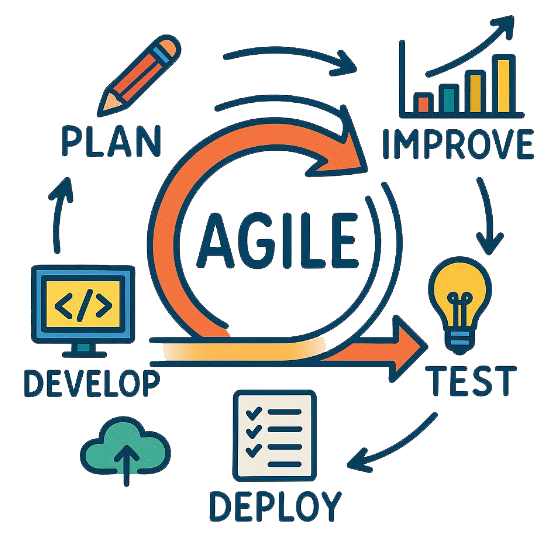
Doing Agile: The Checklist Mentality
Organizations “doing agile” treat agile as a checklist of practices to follow. For example:
• Teams conduct daily stand-up meetings but use them as status updates rather than collaborative problem-solving sessions.
• Sprints are planned and executed, but with rigid timelines that leave no room for iterative improvement.
• Retrospectives are held, but feedback is ignored or inadequately addressed.
This approach often stems from a misunderstanding of agile as a methodology rather than a mindset. Leaders might view agility as a quick fix for inefficiencies or a way to stay competitive, leading to superficial adoption of practices without cultural transformation
(Rigby, Sutherland, & Takeuchi, 2016).
Being Agile: A Cultural Transformation
“Being agile” involves embedding agile principles into the organization’s culture. It requires a shift in behavior, mindset, and values at all levels of the organization. Key characteristics of “being agile” include:
1. Customer-Centricity: Prioritizing customer needs and continuously delivering value.
2. Empowered Teams: Trusting teams to make decisions and take ownership of their work.
3. Collaboration and Transparency: Encouraging open communication and crossfunctional teamwork.
4. Embracing Change: Viewing change as an opportunity rather than a disruption.
Organizations that embody these principles align their actions with the agile manifesto, leading to genuine agility. For example, Spotify’s “Squad Model” fosters a culture of collaboration and innovation by allowing teams to operate autonomously while aligning with broader organizational goals (Kniberg & Ivarsson, 2012).
The Consequences of Misalignment
When organizations focus solely on “doing agile,” they risk falling into several traps:
• Superficial Adoption: Teams may follow agile rituals without understanding their purpose, resulting in inefficiency and frustration.
• Resistance to Change: Employees may view agile practices as an additional burden rather than a facilitator of better outcomes.
• Erosion of Trust: Leaders who micromanage under the guise of agile undermine the autonomy and empowerment that are critical to agility.
These pitfalls not only prevent organizations from achieving true agility but can also lead to disillusionment with the concept altogether, driving them further away from its benefits.
Strategies for Being Agile
To transition from “doing agile” to “being agile,” organizations must focus on fostering an agile culture. Key strategies include:
1. Leadership Commitment: Leaders must model agile behaviors, such as openness to feedback, adaptability, and a focus on outcomes rather than processes (Denning, 2016).
2. Continuous Learning: Encourage a culture of experimentation and learning, where failures are seen as opportunities for growth.
3. Alignment with Values: Ensure that agile practices are implemented in a way that aligns with the organization’s values and goals.
4. Empowerment and Trust: Empower teams to make decisions and provide them with the resources and support needed to succeed.
5. Focus on Outcomes: Shift the emphasis from outputs (e.g., number of sprints completed) to outcomes (e.g., customer satisfaction, value delivered).
Conclusion
The distinction between “being agile” and “doing agile” is pivotal for organizations seeking to thrive in a dynamic business environment. While “doing agile” involves adopting practices, “being agile” requires a fundamental cultural transformation that aligns actions with the principles of the Agile Manifesto. By embracing this mindset, organizations can unlock the true potential of agility, fostering innovation, resilience, and sustained success.
Murat Özbilen
P.M.P. ®, Certified Scrum Product Owner, Certified Agile Coach, Scrum Master Certified
Senior Partner
Global Business Management Consultants
Improving performance through project management
www.globalbusinessmanagementconsultants.com
E-Posta : [email protected]
Referanslar
Beck, K., Beedle, M., van Bennekum, A., Cockburn, A., Cunningham, W., Fowler, M., … &
Thomas, D. (2001). Manifesto for Agile Software Development. Retrieved from
https://agilemanifesto.org/
Denning, S. (2016). The Age of Agile: How Smart Companies Are Transforming the Way Work
Gets Done. HarperBusiness.
Kniberg, H., & Ivarsson, A. (2012). Scaling Agile @ Spotify. Retrieved from
https://blog.crisp.se/
Rigby, D. K., Sutherland, J., & Takeuchi, H. (2016). Embracing Agile. Harvard Business Review,
94(5), 40-50.